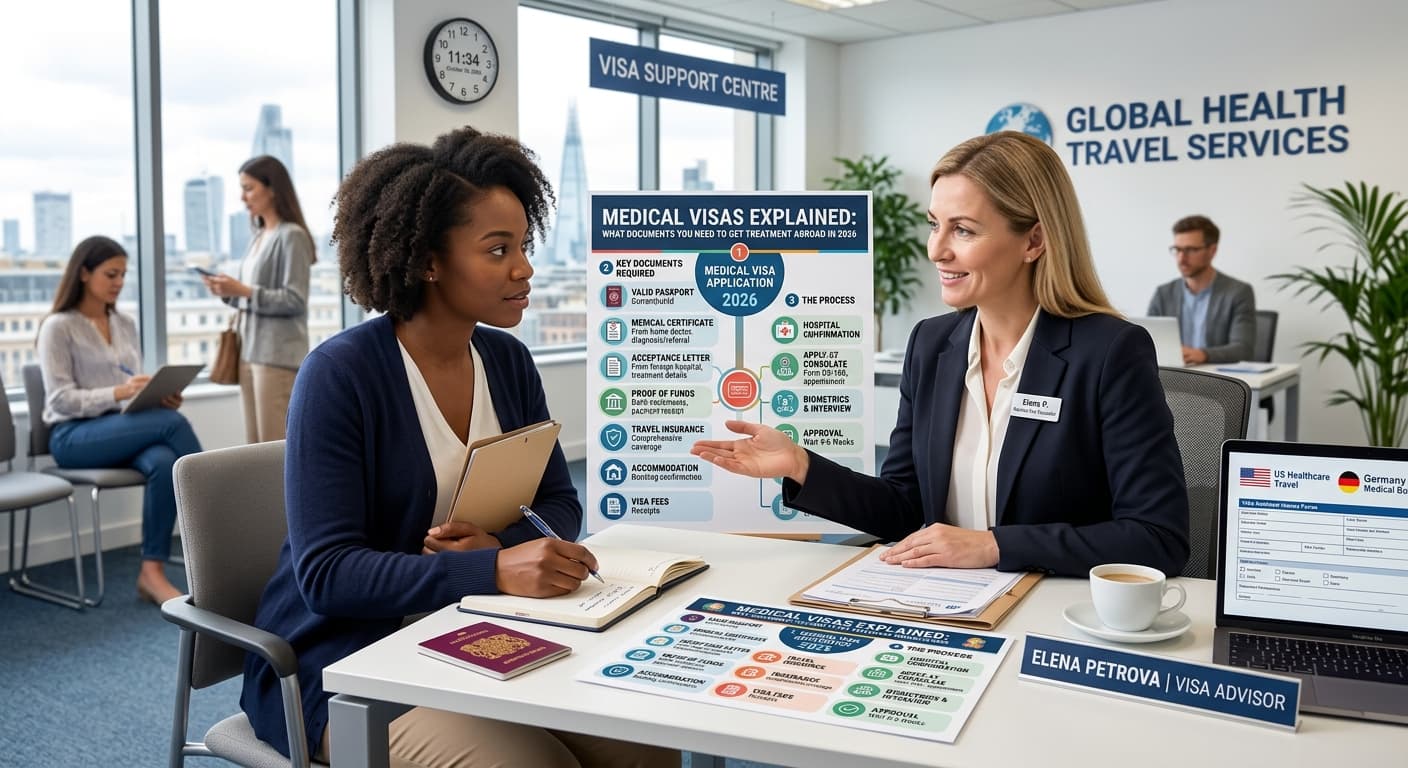
The paperwork that actually gets you into an operating room
Nobody researching treatment abroad wants to think about visas first. They want the hospital, the surgeon, the price comparison. Fair enough. But medical visa requirements are what decide whether any of that happens on the date you booked, and getting one document wrong routinely adds three to six weeks to a timeline that your diagnosis might not have.
Here's the part most guides gloss over: a medical visa is not a tourist visa with a different name stamped on it. Consulates treat them as entirely separate categories, with different sponsors, different proof, and different people reviewing the file. Walking in with tourist-visa paperwork for a cardiac bypass is the single most common reason applications bounce back.
Medical visa vs tourist visa: why you can't just wing it on a holiday visa
A tourist visa assumes you're spending money as a visitor, not as a patient. Some countries will let you receive emergency treatment on one, but scheduled procedures, pre-booked surgery, or ongoing care almost always require a dedicated medical category. Immigration officers check this at the border too, not just at the consulate, and a patient arriving on a tourist stamp with a hospital admission date already set has been turned back before.
The practical difference shows up in three places: length of stay, what proof you need, and who can accompany you. Medical visas typically allow longer stays tied to a treatment plan rather than a fixed thirty or ninety days. They also require a sponsoring hospital, which a tourist visa never does.
Where this gets complicated for patients from restricted countries
If you're applying from a country with limited diplomatic relations with your destination, the medical visa application process can involve an extra layer entirely — additional clearances, longer processing windows, or routes through a third country. This is exactly the situation covered in detail for Can Pakistani Nationals Get Medical Treatment in India in 2026? Visa Status & Best Alternatives, which walks through what's realistic versus what gets stuck in processing indefinitely.
What actually goes into a medical visa documents checklist
Every country has its own order of operations, but the core set barely changes. You need a passport with real room left in it, a hospital invitation letter, proof you can pay, insurance meeting a minimum threshold, and photos that meet biometric standards most people get wrong the first time.
Document | What it actually needs to show |
|---|---|
Passport | Validity well beyond your return date, not just past it |
Hospital invitation letter | Named physician, diagnosis, cost estimate, letterhead |
Financial proof | Bank statements or a deposit receipt covering the treatment estimate |
Travel health insurance | Meets the destination's minimum emergency and repatriation coverage |
Biometric photo | Recent, plain background, exact size specified by that consulate |
For German Schengen medical treatment visas specifically, your passport has to have been issued within the last ten years and stay valid for at least ninety days past your intended return, a detail confirmed by Visametric. A surprising number of rejections trace back to exactly this, usually because the applicant's passport is fine for travel generally but doesn't clear that specific margin.
The hospital invitation letter is doing more work than you think
Consulates treat this letter as the anchor of the whole file. A vague one — "patient requires treatment" with no further detail — gets flagged almost every time. A letter that holds up names the treating physician and their registration number, states the diagnosis or procedure in plain clinical language, gives an estimated treatment duration, and includes a cost estimate on official letterhead with a signature and stamp. Ask the hospital's international patient coordinator for this by name; most accredited hospitals have a template they use constantly and can turn around in 48 hours.
Money: the part that quietly derails more applications than the medical paperwork does
Consulates want proof you can pay for treatment without becoming a financial liability in their country. That usually means bank statements covering several months, sometimes a formal deposit paid to the hospital in advance. What rarely gets mentioned anywhere is what happens when that deposit has to cross borders.
Large wire transfers to a foreign hospital account, sent before your visa is even approved, can trigger anti-money-laundering holds on either end — sometimes for a week or more, right when you need the receipt to finish your application. If you're sending anything over roughly USD 10,000, ask your bank in advance what documentation it wants for an international medical payment, and ask the hospital whether they accept a smaller confirmed deposit upfront with the balance due on arrival. Many do, specifically because this problem is so common.
Currency restrictions compound this. Some countries cap how much currency a resident can legally move out per year for medical reasons, which means the person actually sending the money, if it's not you, may hit a ceiling you didn't know existed. This is worth confirming with a bank officer directly rather than assuming the hospital's finance office will flag it for you.
Insurance minimums nobody reads until the consulate asks for them
Travel health insurance for a medical visa isn't optional padding — it's a hard threshold in most jurisdictions. For a Schengen medical treatment visa, you need emergency medical and repatriation coverage of at least €30,000, a figure set by Italy's Ministry of Foreign Affairs. That number covers emergencies and getting you home if things go badly; it is not the same as coverage for the planned procedure itself, which the hospital's cost estimate handles separately.
Other countries set their own floors, and they're rarely identical, so check the specific consulate's page rather than assuming a Schengen number transfers elsewhere. Malaysia, for comparison, runs its medical eVisa through a flat fee structure instead: a USD 25 visa fee plus a USD 20 processing fee, with approval typically landing in three to five working days, according to the Malaysian government portal.
Bringing a caregiver: the attendant visa most people don't know exists
You are allowed to travel with someone in most countries, but it has to go through an attendant or companion visa, not a second tourist application. Malaysia's immigration guidelines for medical treatment restrict patients to a maximum of one escort under the attendant pass, confirmed directly by Malaysia's Immigration Department, and other countries run similarly tight limits.
The attendant's documents usually mirror a slimmed-down version of your own file: passport, photo, proof of relationship to the patient, and a letter from the hospital confirming your admission so the companion's application has something to attach to. File both applications together where the consulate allows it. Filing the attendant's paperwork separately, a week later, is how families end up with a patient admitted and a spouse stuck at home.
Carrying medication across the border nobody warns you about
If your treatment involves controlled substances — strong opioids for post-surgical pain, certain psychiatric medications, injectable biologics — bringing them with you or picking them up locally is a legal question most visa guides skip entirely. Some countries require a doctor's letter plus a limited personal-use quantity declared at customs; others ban specific drug classes outright regardless of your prescription.
The rule to work from: never assume your home prescription travels with you automatically. Ask the destination hospital's pharmacy department directly, by name of the medication, before you fly. A narcotic that's routine at home can be a customs seizure elsewhere, and "but my doctor prescribed it" has no legal standing at a border checkpoint that doesn't recognize your doctor's license.
Extending a medical visa when recovery runs long
This is the scenario almost nobody plans for and almost everybody eventually hits: the surgery went fine, but recovery is taking longer than the visa allows, and you're asking how to extend a medical stay from a hospital bed rather than a planning desk at home. Doing this well starts before you ever need it.
Keep a dated letter from the treating physician on file throughout your stay, updated whenever your prognosis changes. If complications push your discharge past your visa's expiry, that letter becomes the basis of your extension request, and most immigration offices want it filed before the current visa lapses, not after. The hospital's international patient office, not the hotel or a travel agent, is who actually submits or co-signs this in most jurisdictions — find out which one applies to your case on day one of admission, not the day your visa is about to expire.
So what does this actually come down to
Every one of these documents exists to answer one question for a consular officer: will this person leave when their treatment ends, and can they pay for it while they're here. Everything else — the letterhead, the bank statements, the insurance certificate — is evidence toward that single answer.
The common advice treats medical visa requirements as a box-ticking exercise, finish the list and you're through. The honest version is messier. Money movement rules, medication laws, and extension procedures vary enough between countries that no single checklist covers all of it, and the gaps are exactly where applications stall. Start with the hospital's international patient coordinator, not a visa agency, and work backward from there. They've filed this paperwork hundreds of times. You're filing it once, and it needs to work the first time.
Common questions about medical visa requirements
Can a family member or caregiver travel with me on a medical attendant visa?
Usually yes, but most countries cap it at one companion per patient. Malaysia's immigration guidelines, for example, restrict patients to a maximum of one escort under the attendant pass, and that escort needs their own set of documents tied to your case.
What is the difference between a tourist visa and a medical visa for healthcare abroad?
A tourist visa assumes you're leaving within a set window and not accessing paid medical services, so hospitals often won't admit you for anything beyond emergency care on one. A medical visa is built around a named hospital, a named condition, and usually allows longer stays and extensions tied to your recovery.
What specific details must be included in the hospital invitation letter for a visa application?
It needs the patient's full name matching the passport, the diagnosis or procedure in plain terms, the treating physician's name and registration number, the estimated treatment duration, and a cost estimate on hospital letterhead with a signature and official stamp.
How do I extend my medical visa if my treatment or recovery takes longer than planned?
You'll need a new letter from the treating hospital explaining the medical reason for the delay, updated financial proof, and in most cases you apply before the current visa expires rather than after. Rules vary sharply by country, so confirm the exact extension office and timeline with the hospital's international patient desk before you need it.
What minimum travel health insurance coverage is required for a medical visa?
For a Schengen medical treatment visa, the minimum is €30,000 in emergency medical and repatriation coverage, a figure set out by Italy's foreign ministry. Other countries set their own floors, so check the specific consulate's requirement rather than assuming one number applies everywhere.